

Posted by Frank Griffo, L.Ac. on Apr 8th 2026
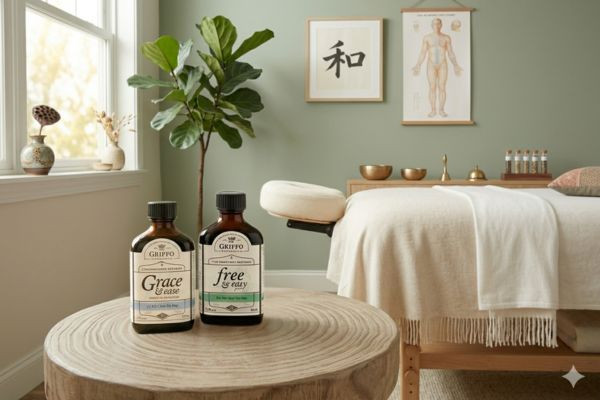
Free and Easy vs. Grace and Ease
Free and Easy vs. Grace and Ease: A Clinical Guide to Xiao Yao San Differentiation for Acupuncturists
Why Xiao Yao San Still Sits at the Center of Modern Practice
Liver qi stagnation is no longer episodic in clinical practice; it is foundational. The combination of chronic stress, irregular diet, poor sleep, and emotional suppression creates a baseline pattern of constraint that continuously disrupts the Liver’s regulatory function. In this environment, Xiao Yao San remains one of the most clinically relevant formulas in the materia medica.
Its durability comes from its architecture. Rather than forcing movement, it restores relationship—between Liver and Spleen, between qi and blood, between movement and containment. The formula treats Liver constraint with underlying blood deficiency and Spleen weakness, a triad that continues to define a large percentage of our patient presentations.
The question in practice is not whether to use Xiao Yao San. The question is how far the pathology has progressed and whether the base formula is sufficient.
Formula Architecture: Understanding the Base Before Modifying It
The classical structure of Xiao Yao San is tightly organized and functionally balanced. Each herb plays a defined role, and the clinical outcome depends on preserving that architecture rather than diluting it.
Chai Hu - acts as the directional force. It clears constraint and restores the dynamic movement of Liver qi. Without it, the formula loses its capacity to initiate change.
Dang Gui and Bai Shao - anchor the energy by tonifing the blood and yin. When blood is insufficient, qi becomes untethered, rising without control or failing to move entirely. Dang Gui both nourishes and moves, while Bai Shao preserves yin and moderates the dispersing nature of Chai Hu.
Bai Zhu and Fu Ling - stabilize the middle. They prevent the Liver from overacting on the Spleen and ensure that transformation and transportation remain intact. This is not supportive in a secondary sense; it is protective of the entire treatment strategy.
Zhi Gan Cao - harmonizes the interaction of the formula, while Sheng Jiang and Bo He regulate the interface between interior and exterior, movement and cooling.
As emphasized by Jiao Shu-De, effective formulas do not rely on strong individual actions but on coordinated relationships. Xiao Yao San exemplifies this principle.
From Constraint to Heat: A Predictable Progression
In practice, pure qi stagnation is transient. If unresolved, it generates heat. This is not theoretical; it is consistently observable across our patient populations.
Emotional constraint creates stagnation. Stagnation generates heat. Over time, that heat penetrates deeper levels—first affecting the channels, then the blood, and eventually the Heart.
This progression explains the shift from mild irritability to pronounced mood instability, from distention to inflammation, and from stress to depressive states with heat signs.
Jia Wei Xiao Yao San addresses this transition directly by adding Mu Dan Pi and Zhi Zi. This modification clears heat from both the qi and blood levels while preserving the harmonizing effect of the base formula. This is the classical pivot point.
Free and Easy: Where It Holds and Where It Fails
Xiao Yao San performs best when deficiency and mild constraint dominate. These patients present with fatigue, bloating, irregular menstruation, and moderate emotional tension without pronounced heat.
Tongue tends toward pale or slightly red edges. The pulse is wiry but often thin or moderate rather than rapid. The system is constrained but not inflamed.
In these cases, forcing heat-clearing strategies prematurely will weaken the patient. The correct approach is to restore movement while supporting blood and Spleen function. Free and Easy does this cleanly. The Griffo version contains small amounts of the heat clearing Shan Zhi Zi and Mu Dan Pi to maintain the principle of balance while initiating gentle heat clearing.
When heat becomes primary—manifesting as irritability, insomnia, premenstrual anger, or inflammatory signs—the base formula no longer resolves the pathology. It moves without clearing. The result is partial relief at best.
Grace and Ease: Extending the Formula to Match Modern Pathology
Grace and Ease is built on the Jia Wei Xiao Yao San framework but extends it to address the depth and complexity of modern presentations. The additions target specific layers of pathology that are now routine in clinical practice.
Regulating the Lower Jiao and Gynecological Axis
Xiang Fu directs the formula into the pelvic basin. Its affinity for the Liver channel and uterus makes it essential in cases of menstrual irregularity, PMDD, and lower abdominal distention. Craig Mitchell emphasizes its role as a regulator of qi dynamics in gynecology, particularly where emotional and physical constraint intersect.
Yi Mu Cao complements this by moving blood and resolving congestion. Its slight diuretic effect addresses fluid accumulation, making it clinically useful in patients who present with both distention and edema during the luteal phase.
Addressing the Emotional Constraint Directly
He Huan Pi operates differently from heavy shen-calming substances. It does not sedate; it releases. By unbinding constrained Liver qi, it restores emotional range and reduces the sense of internal pressure that defines depressive states. This process aligns closely with the intended action of Xiao Yao San but is often insufficient in the base formula alone.
Clearing Heat at the Blood and Heart Level
Dan Shen extends the formula into the blood level while simultaneously calming the shen. This dual action is critical in patients with irritability, insomnia, and cardiovascular tension patterns associated with chronic constraint.
Yu Jin works more directly on the Heart. It clears constrained heat and opens the orifices, making it particularly relevant in presentations involving depression, emotional numbness, or a sense of mental fog.
Protecting Yin While Clearing Heat
Sheng Di Huang provides a necessary counterbalance. As heat persists, it consumes fluids and destabilizes the system. Without yin support, aggressive movement and clearing will worsen long-term outcomes.
Its inclusion ensures that the formula remains sustainable for patients in perimenopause or those with chronic heat patterns and underlying deficiency.
Clinical Differentiation: Practical Decision Points
The choice between Free and Easy and Grace and Ease should be made quickly and decisively based on a small number of reliable indicators.
Use Free and Easy when:
- Liver-Spleen disharmony is primary without significant heat signs
- Fatigue and deficiency are more prominent than irritability
- Tongue is pale or mildly red at the edges
- Pulse is wiry but not rapid
Use Grace and Ease when:
- Heat signs are clear: irritability, insomnia, acne, flushing
- PMDD presents with anger, breast tenderness, or cycle-linked inflammation
- Perimenopausal symptoms include hot flashes and emotional volatility
- Depression presents with constraint, agitation, or internal heat
- Tongue is red, especially at edges or tip, with possible yellow coat
- Pulse is wiry and rapid
Tincture Delivery and Preservation of Volatile Compounds
The method of extraction materially affects clinical outcomes. Aromatic herbs such as Chai Hu and Bo He rely on volatile compounds that are degraded by prolonged heat. For formulas designed to move qi loss of volatile constituents due to boiling reduces efficacy in exactly the cases where precision matters most.
Griffo's warm percolation dual extraction preserves both water-soluble and alcohol-soluble fractions, maintaining the full pharmacological profile of the formula.
Clinical Application in the Modern Practice Environment
In the current clinical landscape, presentations involving stress, hormonal transition, and mood disorders dominate patient volume. PMDD, perimenopause, and stress-related depression frequently present with mixed patterns of constraint, heat, and deficiency.
This makes the distinction between base harmonization and extended modification operational rather than theoretical. Practitioners who rely exclusively on Xiao Yao San will under-treat a significant portion of these patients.
Precision in formula selection directly impacts retention, outcomes, and patient trust. The shift from Free and Easy to Grace and Ease is not escalation; it is alignment with the pathology in front of you.
Xiao Yao San remains foundational because it reflects a correct understanding of physiology. But modern pathology requires extension of that model. When heat, blood involvement, and emotional constraint deepen, the formula must evolve accordingly. Free and Easy restores baseline harmony. Grace and Ease addresses the layered, heat-driven constraint that defines a large percentage of contemporary cases. The distinction is straightforward when viewed through the lens of heat, depth, and system involvement. Applied correctly, the difference is measurable in both speed and durability of clinical results.